
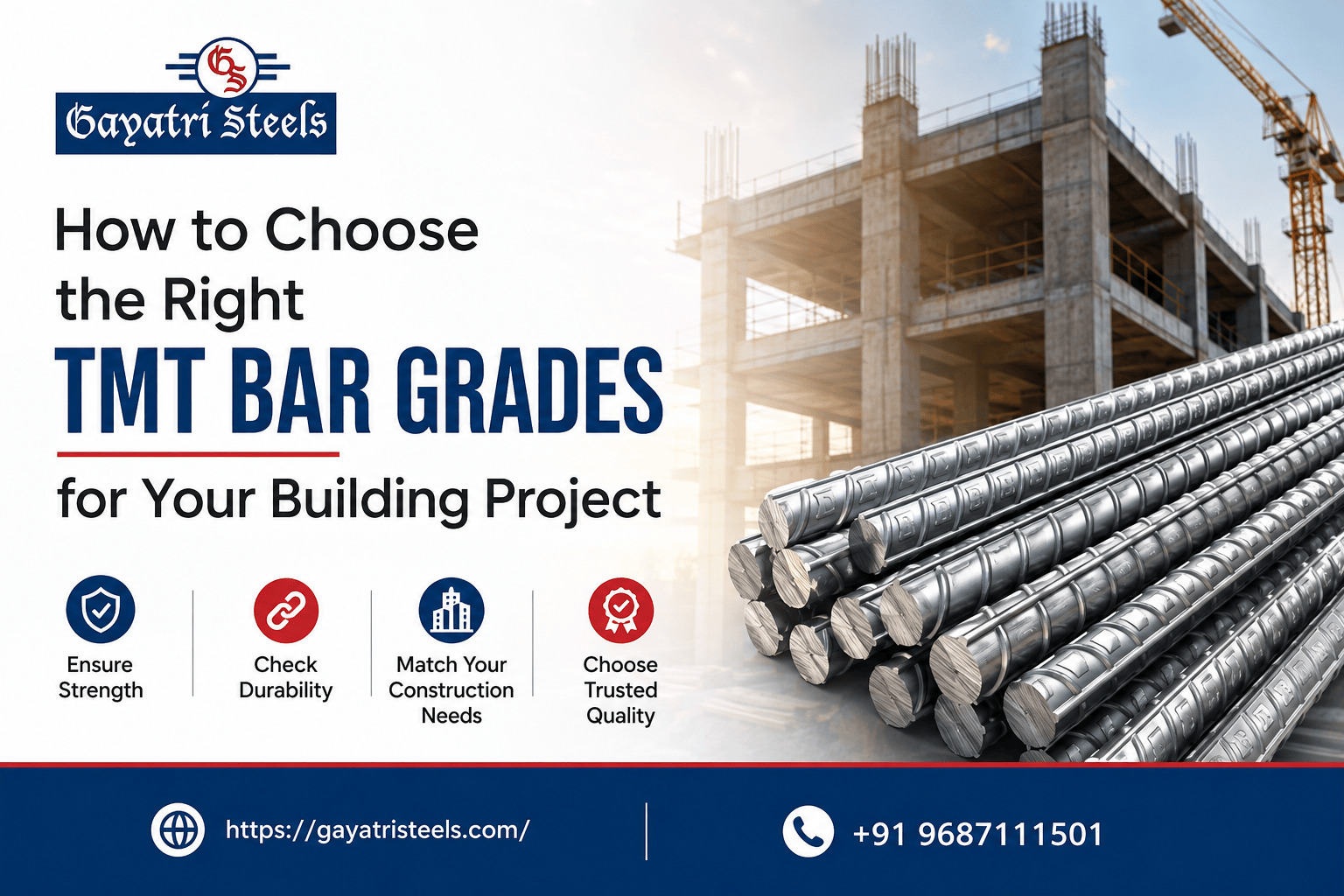
How to Choose the Right TMT Bar Grades for Your Building Project
08
Feb , 2026How to Choose the Right TMT Bar Grades for Your Building Project
Picking the wrong steel reinforcement isn't something you can fix later without tearing into the structure. TMT bars end up locked inside your building's frame, so their strength, ductility, and overall quality genuinely matter — not just on paper, but for decades of use.
Most of the confusion kicks in the moment someone sees a quotation listing Fe 500, Fe 500D, Fe 550, and Fe 550D side by side. It's tempting to assume the bigger number wins. It doesn't — not always, anyway.
The right TMT bar grades depend on the structural design, building type, load requirements, ductility, applicable standards, and the recommendation of a qualified structural engineer. Here's how to understand the differences before placing your order.
What Are TMT Bar Grades?
TMT stands for Thermo Mechanically Treated steel, and these bars are the standard reinforcement used inside RCC structures — foundations, columns, beams, slabs, you name it.
The grade number tells you the minimum yield strength, measured in MPa. So Fe 500 means a minimum yield strength of 500 MPa, and Fe 550 bumps that up to 550 MPa.
Then there's the "D." Grades like Fe 500D and Fe 550D carry higher ductility requirements than their standard counterparts. Ductility is what lets a structure bend and absorb stress instead of snapping outright under pressure — a quality that matters a lot more than people realize until it's tested.
So don't just chase the strength number. Strength and ductility work together, and both deserve a look.
TMT Bar Grades Comparison at a Glance
|
TMT Grade |
Minimum Yield Strength |
Ductility |
Common Use |
|
Fe 500 |
500 MPa |
Standard |
General RCC construction |
|
Fe 500D |
500 MPa |
Higher |
Residential and demanding applications |
|
Fe 550 |
550 MPa |
Standard |
Structures needing higher strength |
|
Fe 550D |
550 MPa |
Higher |
Projects needing both strength and ductility |
Which TMT bar grade should you choose? For a lot of residential builds, Fe 500 or Fe 500D fit the bill. Fe 550 and Fe 550D tend to get specified where higher strength is genuinely required. Either way, the final call belongs to your structural engineer, not the supplier's price sheet.
Understanding Fe 500, Fe 500D, Fe 550 and Fe 550D
Fe 500 Steel
Fe500 steel has a minimum yield strength of 500 MPa, used across residential and commercial construction wherever it's called for in the drawings. It's popular because it strikes a solid balance between strength and workability, not because it's the "default" choice. Never swap in Fe 500 just because it's what's sitting in stock — check the drawings first.
A TMT bar Fe 500 can be used in residential, commercial, and other construction projects where this grade is specified by the structural design.
Fe 500D
Fe 500D belongs to the same 500 MPa class as Fe 500, but built for higher ductility. This matters when a structure needs more room to flex before it fails. That doesn't make Fe 500D automatically superior to Fe 500 — they're built for different jobs, and the engineer's spec decides which one fits.
Fe 550 Steel
Fe550 steel offers a higher minimum yield strength than Fe 500. Useful where the design calls for extra load-bearing capacity, but switching to a higher-strength bar changes how the rest of the reinforcement is calculated. It's not something to decide on your own at the shop counter.
Fe 550D
Fe 550D combines the higher strength category of Fe 550 with higher ductility requirements. Often specified where a structure needs both qualities at once. As always, the number on the bar means nothing without the engineering behind it.
Fe 500 vs Fe 500D: Which One Should You Choose?
|
Feature |
Fe 500 |
Fe 500D |
|
Strength category |
500 MPa |
500 MPa |
|
Ductility |
Standard |
Higher |
|
Typical consideration |
General RCC applications |
Applications where greater ductility is required |
|
Selection |
Based on structural design |
Based on structural design |
Is Fe 500D just the better version of Fe 500? Not really. It's a better fit when higher ductility is required — but that's a call your structural engineer needs to make, since requirements can shift between a foundation, a column, and a slab even within the same building.
Fe 500 vs Fe 550: Which TMT Grade Is Better?
The core difference is strength: Fe 550 simply has a higher minimum yield strength than Fe 500. But higher strength isn't a blanket upgrade.
A house designed around Fe 500 doesn't suddenly need Fe 550 just because it sounds stronger. Whatever grade the engineer chose was based on the building's loads, the reinforcement detailing, the concrete grade, and the actual calculations behind the design. Paying more for a higher grade without a structural reason to back it up is money spent on nothing.
Fe 500D vs Fe 550D: What Is the Difference?
Both are D-grades, so both carry the higher ductility requirement. The difference comes down to strength class:
- Fe 500D — 500 MPa, higher ductility
- Fe 550D — 550 MPa, higher ductility
Some projects are designed around the extra strength of Fe 550D; plenty of others do just fine with Fe 500D. Don't pick between them based on the name — check the drawings and talk to the engineer on the project.
Which TMT Bar Grade Is Best for Different Building Projects?
|
Project Type |
Grade Consideration |
|
Individual house |
Fe 500 or Fe 500D, as specified |
|
Residential apartment |
Fe 500D or another specified grade |
|
Commercial building |
Fe 500D, Fe 550 or Fe 550D, depending on design |
|
Industrial structure |
Fe 550 or Fe 550D where specified |
|
High-load structure |
Higher-strength grades where required by design |
|
Demanding/seismic applications |
D-grade reinforcement where specified |
Treat this as a starting point for conversation, not a substitute for actual structural calculations. Your engineer confirms the exact grade, diameter, quantity, and layout for your project.
7 Factors to Consider Before Choosing TMT Bar Grades
- Building type — A two-storey house and a factory shed don't need the same reinforcement, obviously.
- Structural load — Different loads on columns, beams, slabs, and foundations can call for different specs.
- Required strength — Higher-strength bars help where the design calls for them; otherwise it's just extra cost.
- Ductility — Determines how much the steel can deform before it gives way — a big deal for D-grades.
- Environmental conditions — Coastal air, humidity, and moisture exposure all affect what reinforcement and protection you need.
- Applicable standards — Make sure the bars meet IS 1786 and whatever else your project specifies.
- Supplier and product quality — The grade on the invoice is only half the story. Reputation, traceability, and test documentation matter just as much.
How to Check TMT Bar Quality Before Buying
Before you sign off on an order, take a few minutes to verify:
- Manufacturer and brand
- Grade and diameter
- Bar markings
- Applicable standard
- Batch or heat number
- Test certificate, if available
- Weight and quantity
- Surface condition
- Supplier paperwork
- Invoice details
Buying from an established supplier makes it much easier to trace where the steel came from and pull the documentation your project needs. And don't chase the lowest quote blindly — shaving a little off the price isn't worth gambling on the quality of your reinforcement.
Trusted TMT Steel Brands Available Through Gayatri Steels
The brand and the supplier both matter when you're buying TMT bars for a construction project. Gayatri Steels is a trusted steel supplier in Vapi, dealing in established brands such as SAIL, Tata Steel, Jindal Steel, and JSW.
Depending on what your project needs and what's available, it's worth discussing grade, diameter, quantity, brand, documentation, and delivery directly with your supplier before placing the order.
If you're sourcing TMT bars in Vapi or the surrounding area, working with an experienced local supplier tends to make bulk procurement a lot smoother.
Common Mistakes to Avoid When Buying TMT Bars
- Buying on price alone — the cheapest quote isn't automatically the best deal.
- Assuming bigger is better — Fe 550 isn't a universal upgrade over Fe 500.
- Ignoring ductility — strength gets all the attention, but ductility matters just as much.
- Skipping the drawings — always confirm grade and diameter against the structural specs.
- Skipping documentation — ask about standards and test certificates.
- Going with an unreliable supplier — consistency and traceability count for a lot.
- Swapping grades without sign-off — never substitute reinforcement without the engineer's approval.
FAQs
1. What are the main TMT bar grades used in construction?
Fe 415, Fe 500, Fe 500D, Fe 550, and Fe 550D are the common ones. The right pick depends on your structural design, strength needs, ductility, and project specs.
2. What's the difference between Fe 500 and Fe 500D?
Both sit in the 500 MPa strength class, but Fe 500D has higher ductility requirements. Which one you need depends on what the engineer specifies.
3. Is Fe 550 stronger than Fe 500?
Yes — Fe 550 falls into a higher strength category. That doesn't mean it's the right choice for every building, though.
4. Which TMT bar grade is best for house construction?
There's no single answer. Fe 500 or Fe 500D often get specified for residential builds, but it depends on the design. Follow your engineer's recommendation.
5. What's the difference between Fe 550 and Fe 550D?
Both are in the 550 MPa class, but Fe 550D has higher ductility requirements. Again, project requirements decide which fits.
Final Thoughts
Choosing reinforcement steel isn't about grabbing the bar with the biggest number stamped on it. Fe 500, Fe 500D, Fe 550, and Fe 550D each bring different strength and ductility characteristics to the table, and the right one depends entirely on how your structure was designed.
Before you order, confirm the grade and diameter your engineer specified, check the product's quality and paperwork, and work with a supplier you can trust.
If you're sourcing TMT bars in Vapi or nearby, Gayatri Steels can help you source the right option based on your project's requirements, quantity, and specifications.